
Tag Archives: Beverages
Protected: Chapter 10
Protected: Chapter 9
Protected: Chapter 8
Aside
Protected: Chapter 7
Aside
Chapter 6
Reply
‘Toast the Roast’
“Now What Do You Do— with the Coffee You’ve Roasted”
“The Abbreviated Version” 🙂
(a series about roasting your own coffee) #4 of 4
By Dahni
©️ 2019, all rights reserved

Map of Coffee World-click for a larger view

One dancing goat, the other one is drinking coffee- click for larger view
From Kaldi and his dancing goats from Ethiopia, to Kenya and Yemen, coffee spread across the world where today—
• Coffee locations on the map all share similar characteristics: tropical and high elevation (among others). The climate must be perfect, for coffee to be grown and thrive!
• Coffee is exported from around 70 countries and imported by most countries in the world! The United States, is one of, if not the biggest importer of coffee in the world! WE the People of the USA, like our coffee!
• Mexico is likely the largest exporter of coffee to the United States! Think about that! Where did your coffee come from? Is it a blend of Mexican and some other(s)?!
• No coffee origins (varieties), are exactly like any other! Even the same origin will not always be the same, every time. Correctly roasted coffee reaches a peak then falls off in about 7-10 days! Coffee in those 7-10 days is always subtle, unique and their nuances different, each day! Some believe that the ONLY place to roast coffee is at the same location where the plants are grown, the cherries are harvested and the green beans (seeds), are processed! If this is true, then wouldn’t the best place to drink coffee be, at the same place where it is roasted? Personally, I am not financially independent, not that particular and not this patient!
• They are not really beans, they are seeds! They are called ‘cherries’, before they become ready for our coffee. They are very odd as, not every “cherry” will produce a seed! It takes around two thousand (2,000), cherries (the ones with seeds), to make our one cup of coffee!
• Because of all the above conditions and more, most cherries are still picked by hand, throughout the world! The terrain of most areas where coffee is grown, prevents most beasts of burden and modern equipment, from reaching the plants to extract the “cherries”!
• Arabica beans are the most desired, but they are also, the most fragile, compared to Robusta! Generally, Robusta beans have more caffeine and are larger beans! Robusta are often used in “blends” and to lower costs, while still charging us more for what they tell, are their, “signature blends”! Arabica beans account for sixty percent (60%), and Robusta, forty percent (40%), of all coffee beans!
• Coffee is the second (2nd), most traded commodity in the world!
• Coffee is the fourth (4th), most consumed beverage in the world, following in order: water, beer, wine and coffee!
• Kona Coffee from Hawaii (one of the most expensive and most popular in the world), is about the only place where commercial and mass quantities of coffee are grown in the United States!
• One of the reasons (among many), Jamaican Blue Mountain (another expensive, popular and my favorite coffee), is so expensive is because, Japan (yes Japan), has had a trade agreement with Jamaica to purchase ninety percent (90%), of their beans (roasted or green), for maybe well over a hundred (100), years!
• Political unrest and instability could potentially halt the export of coffee from that country, at anytime! Think about that and ask yourself what you would do, if tomorrow morning your favorite coffee was no longer available??? This is another wonderful reason to order green beans at a current price and not at a higher price in the future and green beans can keep for years, in a cool dark place! Need I mention the importance of trying new coffees and educating your palate? ROAST YOUR OWN COFFEE!

Brewed Coffee and Beans
Brewed Coffee
The most obvious thing to do after roasting your beans is to grind them and brew, and have a cup or two or a few. If you have never had coffee this fresh and that it’s not over-roasted, you just might be tasting coffee as it was meant to be enjoyed, for the very first time??!! If you usually drink coffee with cream, sugar or both, you may be surprised how great your roasts taste, drinking it black??!! Enjoy the flashback ‘Percolator ‘ song, from the YouTube video to follow. 🙂
OK, what next?
What to do with those grounds? Do you have roses or hydrangeas? Share your grounds, they like coffee too. One of the reasons for this is due to the acidity in the coffee that plants like. OK, what next?
Decaf? There is no such thing! Most coffee marketed and sold as decaffeinated is around 97% caffeine free. Well, that still leaves around 3% caffeine doesn’t it? What I’m calling it is, Locaf (lower caffeinated) Coffee.
Locaf or Lower Caffeinated Coffee
Sometimes, you or your others, may or would like a cup of coffee before say, bedtime. Maybe you don’t need the energy or the buzz from caffeine and you don’t want to stay awake all night. 🙂
To remove caffeine, it begins with green beans ONLY! There are only 2 ways to remove up to about 97% of the caffeine from coffee:
1. Chemicals- Not for me!
2. Water- The most natural and organic! For anything and everything you may or may not want to know about so-called decaffeination (lowered caffeine, but never all), click here
Want it? Need it? Well, you have three choices:
1. Buy whole beans or ground decaffeinated (Locaf), coffee. But if you are a home roaster or want to be, why would you?
2. Buy green beans that have most of the caffeine (never all), removed and roast yourself. NO PROCESS CAN REMOVE ALL OF THE CAFFEINE! But I would only choose green beans that use the water process, to remove caffeine (whatever amount is removed)! Where to get them? click here
3. Do it yourself! How? Well, it will take some time!!! Place your green beans in a bowl. Pour hot water onto the beans and cover them with the hot water. Let them soak, for a few minutes. Drain and rinse. Repeat. Each time you do this, more of the caffeine is removed. When finished, roast the beans to your satisfaction.
Did you know, there are over 1,200 complex compounds in coffee, which contribute to their flavor profiles?? There are!!! Uhh, why then, would anyone want to over-roast and mess up any of these flavor compounds??? Just Don’t!!! Sugar is just one of the compounds. Caffeine is another. But it is odorless and colorless, though it does contribute acidity, which does affect, the overall taste of some coffees.
Note: There is more information available on this to class participants or online subscribers. See classes- click here
OK, what’s next?
Blends or Blending
Blends could be something you might like? Blends are for two real reasons, in the coffee industry:
- By using inferior beans and over roasting, costs can be cut and it can be marketed and sold as a signature blend and charge more for it.
- You really want to produce a signature blend with something unique. Or, maybe you had no choice? Look back to the South during the Civil War. The North was often blocking the southern waterways and prevented or disrupted the supply of coffee. They either had to make some dark beverage from roots and other stuff besides coffee or they stretched the coffee by adding other grains and etc. to it.
Chicory was once such grain and it is still popular in the south, particularly in Louisiana. Have you ever heard of Cafe du Monde? It is world famous and started in New Orleans in 1862. They are open seven days a week; year-round, except, for Christmas Day or if an occasional hurricane forces them to close. We still have a can of this in our freezer (not a good idea to store this way, but it’s done). My wife Susan, actually had this coffee in New Orleans. I first tasted it in Japan. Yes, it’s all over the world. But in a can? How fresh can [pun-ny], that be? What if you made your own? Yes, yes you can!


Coffee blended with pine nuts
Another blend I liked and tasted, is roasted in New Mexico, USA. It is coffee made with pinions (pine nuts). It is very unique, but how long can it stay fresh in a can or even a nitrogen packed can or foil bag? When was it roasted? How many months ago was that? How many months hence, from the date of roasting does the package read, “Best if used by [some date way into the future]”. Why not roast this blend yourself? I will be, as soon as possible!
Blends and Dark Roast
Do you like or do your friends and family like espresso, latte, macchiato, cappuccino and other dark roasted beverages? Then roast some! It is easy to do. Any coffee, if dark roasted, can be used for any of the beverages above. But here is where blending or blends come in. I wanted to try this and I mixed three (3), different coffees from different countries. One was from Ethiopia.
In our classes, we use Ethiopian coffee to roast. Class participants get to sample some fresh brewed, from fresh ground, and from fresh roasted coffee beans. And they each receive a 1/4 pound of fresh roasted beans, they can take home and enjoy the next morning. Now by “fresh” I mean, coffee beans that were roasted 24-48 hours before shared.
Two of the class members will each receive 1/2 pound of the coffee I roast at the actual class. Chosen by having the winning ticket selected, one receives from the popcorn popper roast and the other from the skillet roast. Obviously, I cannot make these available online and I do not have the means or the desire to be roasting around 7 pounds of coffee beans (what is needed for a class of 14), more than once or twice a week! But also, in class and by way of a special password required protected location and for a limited time ONLY, class members will receive the actual recipe I used, for making my dark blend, for espresso and etc. For more info. on classes and etc. click here Again, Ethiopian is the coffee used for classes, for obvious reasons. It was probably the “FIRST COFFEE”, many people have never tried it, it is one of the most popular and it is great in a blend, for espresso and etc.
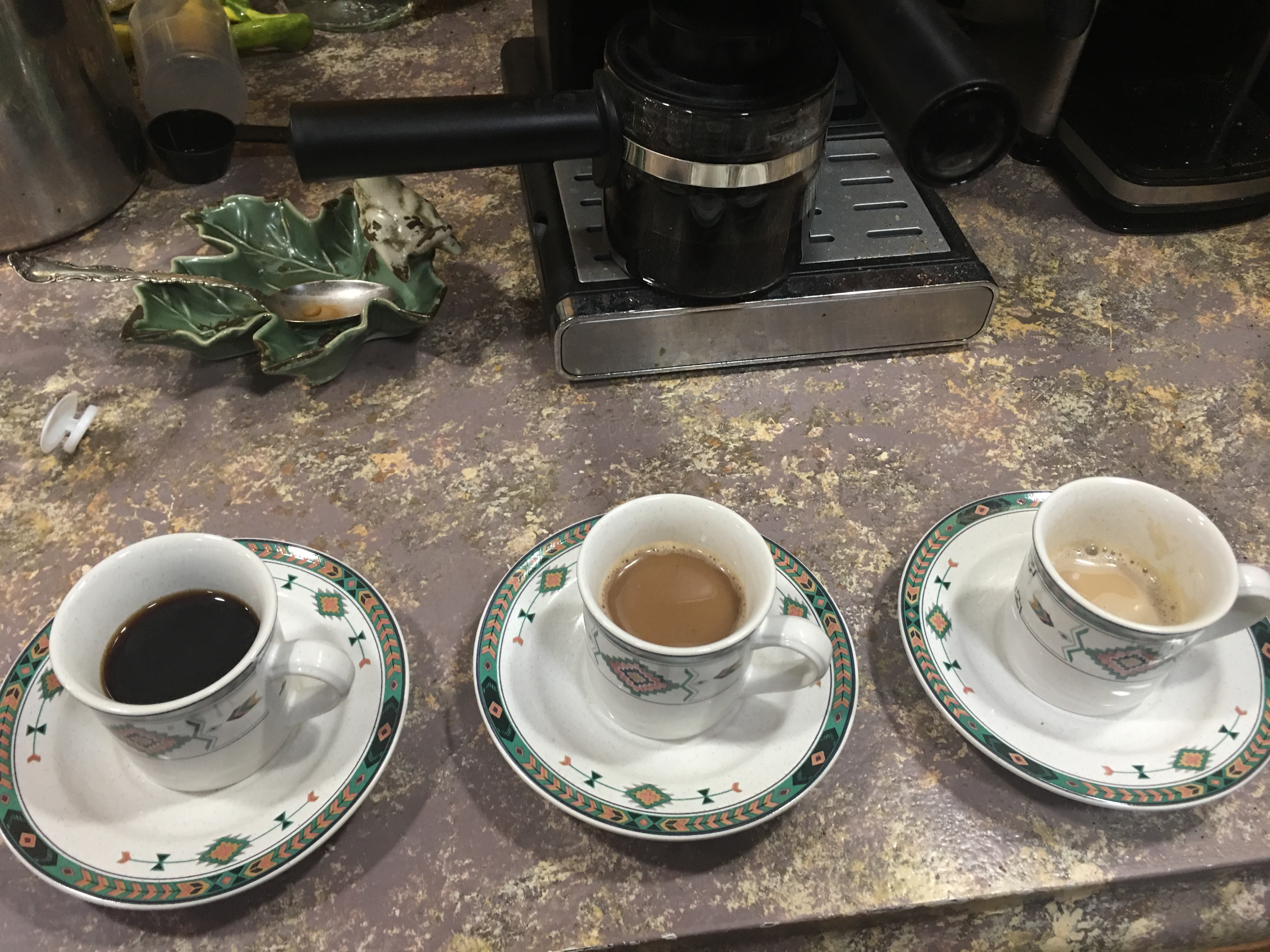
Various beverages from dark roasting-click for larger view

This could be your dark roasted beans- click for a larger view
Note on Blends/Blending: Technically, each coffee used in a blend, should be roasted separately and then blended. But I only made a 1/2 pound of dark roast and I roasted all three (3), different coffees together, at the same time. You are probably expecting this, but you will have to take my word for it (or take a class, learn the recipe and roast it yourself), but it made the freshest and best cup of espresso, latte, macchiato and cappuccino, my wife and I have ever had! Then I did another, not-supposed-to-do thing. I put it in a plastic sandwich bag, in a sealed black plastic container and stuck it in the freezer. Oh Noooo! 🙂
If needed or desired, I have my dark roast on hand, for anyone that comes to ‘The Gathering Place’ (what we call our home). I will be roasting this again, if/when needed, but especially for, the winter holidays! OK, what next?
Roasting for espresso? Have you ever had or do you like eating espresso beans? How about chocolate covered, espresso beans?! I have recipes for these too! Take a class and/or become a subscriber. click here OK, what’s next?
Latte Art
Have you ever seen or had one of those extraordinary and barista artist created designs with cream, on top of your dark beverage?

Latte Art- click for a larger view

Latte Art You Could Make at Home
Do you think these might add to the cost of your cup? Why not make your own? They do not have to be complicated and so detailed and complex, that you regret destroying the art when you or someone drinks your cuppa! I’ve seen some that are so detailed, they look like famous people, animals and all kinds of stuff! Do you you think these might add to the time it takes to get a cup, and drink it and that your coffee may not be as hot as you may like it, depending on how long it takes to make and get it to you?? Please do not misunderstand me. I like, admire, respect and appreciate art and artists. But as a former chef, there is a line I just won’t cross. That line is in the middle of Impress and Bless. There is nothing wrong with presenting food and drink in a beautiful or visually pleasing manner. It actually aides in digestion, promotes good conversation and increases enjoyment or JOY! But If I want to, have to or feel the need to impress you, I have crossed the line over my desire to simply, Bless You! And, like anticipating and expecting and waiting on a good meal or beverage to come, I just don’t have the patience to wait for say, da Vinci’s ‘Mona Lisa’ to be made with cream, on top of my coffee. And as a former chef, I don’t have the patience to wait to see your reaction to what I’ve prepared especially for you! Still, latte art is cool. You can learn to do some really simple, gorgeous, beautiful (find your own adjectives), latte art which will bless your guests and not take forever and a day to make. The word bless means, “Highly Favored!” For more information, to take one of our classes and/or become a subscriber. Click here Or wait until I finish my book (see below). OK, what’s next?
Cold Coffee (iced) or Cold Brew

Cold Coffee-click for larger view
Have you ever had or do you like, Cold Coffee or Cold Brewed Coffee? What’s the difference? Cold coffee is just like it is written. It is coffee that has been brewed and allowed to cool. It is served at room temperature, cool, cold, ice cold or with ice. It is served, with or without cream and or sugar. Cold Brew is just like brewing sun tea in a glass jar, in a filter (or a tea ball), and allowed to sit in the sun (or even on your counter-top). I call this, ‘Sun Coffee’ 🙂
Each (Cold Coffee or Cold Brew), have their own unique tastes, and depend on the origin of the coffee they are made from.

Sun Coffee- click for a larger view
One of our grandfathers (a proper man and a highly educated man), liked cold or cooled or chilled or room temperature coffee (whatever was his preferred temperature). He would make coffee in a glass-top metal percolator, on top of his stove. Then he would pour some out into a nice teacup, which sat on a matching saucer. He would let this cool, pour some into the saucer, set aside the cup and raise the saucer and drink form it. I never saw him do this in public. I do not know if it is civilized or acceptable in public or how Emily Post or Miss Manners (two culture, class and etiquette champions), would view this, but it was his home, his castle, his private time and it made him happy! To be honest, I was not a fan of coffee that has any other temperature than hot enough to burn my lips! Hosting others and serving others is a responsibility and should be a joy to all chefs. Seek to bless and not impress! But I concede these (Cold Coffee or Cold Brew), have a place and FYI (for your information), I am warming up (or cooling down), to the idea! 🙂
You can add some spices and (natural flavorings), to either of these, to really transform your summer-cool-off beverages or whenever you want your coffee for your own personal, Chill Out! 🙂
I’ve recipes for these too, also either available from online, for class participants, subscribers only or when completed and published, in my book—
‘The Gathering Place Feast Book’
(“How anyone can turn their home into a 5 star restaurant!”)
By Dahni
Note: If you like Nitro (nitrogen treated), Coffee, I cannot help you. I don’t care for it, my wife Susan does, but I certainly do not have the necessary equipment or nitrogen sitting around in my mad-scientist lab in the basement! And there will not be one in the future, either, EVER! 🙂
OK, what’s next?
Other Beverages with Coffee
Other beverages with coffee? Like what? How about Adult Beverages (alcohol or non-alcoholic), for your Libations and Happy Together Hours! Coffee Liqueur made by you? Absolutely! How about a home-made ‘Coffee-tini’ by your’s truly, Dahnini or Dahnitini, mixologist; drink meister extraordinaire! 🙂
Desserts With Coffee
Coffee ice cream, coffee cake, tiramisu, coffee pie, coffee cookies anyone? We’ve got em’ and a lot more. Make your own! Make up your own.
Coffee as a Spice
Ground coffee as a spice? Sure, why not? Use as a rub, or part of a meat sauce for hamburgers and etc. The possibilities are endless. Use it. Make up some great stuff!
Coffee in Art & Literature
Yes! I’ve used coffee as a watercolor background, for some of my photograph turned paintings. Remember, Thomas Jefferson loved coffee and said it was the most civilized drink in the world. He may have had coffee when he was working on the drafts, to the Declaration of Independence. Maybe our Founders of this wonderful Republic of Ours, consummated its signing, before, during or after, with coffee. Poets and authors wrote and write, while consuming coffee. I have a cup of coffee beside me, as I am writing this. Now maybe this is not literature, but I am writing and I am drinking coffee, while doing it!

‘Ever Notice’ By Dahni © 2006 Background is painted with coffee- click for larger view
Coffee Around Your Home
I’ve already mentioned using your used coffee grounds, on roses and hydrangeas. It’s great fertilizer. Coffee grounds contain several key minerals for plant growth — nitrogen, calcium, potassium, iron, phosphorus, magnesium and chromium. Compost with 40% coffee produce less green-house gas and contributes greatly, to some of the best quality compost. Coffee around your plants helps create a barrier that slugs and snails do not like to crawl over. Coffee grounds contain compounds that are toxic to many insects. You can use your coffee grounds to repel mosquitoes, fruit flies, beetles and other pests. Coffee grounds contain nitrogen, which helps eliminate odors. Try placing some roasted beans in your refrigerator or really, anywhere you want to neutralize odors. Place some grounds by your sink for scrubbing your hands, after handling onions or garlic. Take some roasted coffee beans in a plastic bag with you, when you go shopping, especially for fragrances, perfume, cologne, scented candles or anything with a fragrance or scent. After sniffing a few fragrances, your ‘nose’ can become overwhelmed and you can hardly sense another aroma’s attributes. Open your bag of roasted coffee beans and sniff them for a few seconds. Your ‘nose’ for new scents will come back to you! Do not worry about what others may think about you sniffing coffee beans at the store. I have found many places offer this technique (service with coffee beans), and I always recommend it to the stores I shop at, if they don’t already offer this. It really does work! Try it! There are seemingly endless and countless ways to use coffee!
Coffee for Your Health and Wellness
Do some research and you will find that coffee consumption has many health benefits. My sister makes a fabulous shower scrub with coffee! My wife, Susan, loves it! Not to get personal or anything, but coffee is a diuretic. It helps eliminate salt and well, it helps you go. Coffee is excellent for constipation, it keeps me regular! Some people use coffee as a laxative. Some use coffee for enemas, to clean-out their digestive tracts and rid it of a buildup of toxins and poisons. Many people who do this, report feeling healthier, happier and much more energetic. That being said, personally, I would rather drink and consume my fresh coffee! There are so many things coffee can do, for us and that we can do with coffee.
For more information on potential health and wellness attributes of coffee (for class participants and subscribers ONLY), see the password protected link for Chapter 9
Coffee for Conversation
In my book, I will have a section on making your own home made ‘Beverages’. I call this section, ‘Sips with Susan’ (my wife). Whether it is during our Happy Together Times (Happy Hour), or our morning coffee, we sit and sip, enjoy one another’s company and converse about little things, no-things of great importance or great things, which truly matter. This is what conversations are for and I truly believe, coffee promotes good conversation. Even if you are a tea drinker, have you ever invited someone or have you ever been invited to, ‘Have a Cup of Coffee’? I’m sure that you have! Even if you are having tea, saying you are having a cup of coffee with someone is a good-feeling, friendly, civil and cultural thing to do! When John F. Kennedy was campaigning for president, he was the first candidate to visit ladies groups and organizations for ‘Coffee Talks’, but he referred to them as “Tea Talks”! 🙂
Coffee as Gifts
Almost everyone loves and craves for, “A Taste of Home,” “Home Made”, “Home Cooking” or just going or being HOME! You could help provide these wonderful and good feelings, by giving away as gifts, some of your roasted coffee beans. Birthdays, anniversaries, holidays and on and on, a gift of your coffee would be like any other special gift, but it’s made by you and it’s FRESH. What about coffee as a home warming gift? The new house owners may be living out of boxes, for awhile, but I bet they have found their coffee maker and it’s in their kitchen. Imagine them sitting around and sipping your coffee, while they decide where to put all their furniture, where to hang or put this and that. How about your coffee, for a baby announcement? Think about the new mom and dad, sitting around and enjoying your fresh roasted beans that they ground and brewed, while they think about names for the baby. A coffee gift of thanks, appreciation, friendship and love? Yes! The possibilities are too numerous to even try and list! The greatest gift that can ever be given is said to be, the gift you give of yourself! You are and your own fresh roasted beans are synonymous. You and your beans are one! Give the gift of yourself! 🙂

Where to Go from Here?
Coffee, it’s Not Just for Waking Up!
This concludes our series on roasting coffee, ‘Toast the Roast’. Remember this, it is really simple to roast your own coffee! I hope like me, you enjoy learning. I hope you have learned something!
Learning is, an Exciting adventure!
I hope you are excited! I close with raising my cup to you, to…
‘Toast Your Roast!’
The next posts are password protected and are subject to removal and/or change at my discretion. It is not open to the public, just you and for a limited time ONLY!
Chapter 7 — ‘Toast the Roast’ “Expanded Supplies & Equipment” PASSWORD PROTECTED
Chapter 5
‘Toast the Roast’
“Roasting Coffee at Home or Wherever & Whenever”
“The Abbreviated Version” 🙂
(a series about roasting your own coffee) #3 of 4
By Dahni
©️ 2019, all rights reserved

Roasting with a Popcorn Popper- click for a larger view

Green Coffee Beans in the popcorn popper (roaster)- click for a larger view
Simple Coffee Roasting Directions Using a Popcorn Popper
The old-fashion hand-crank popcorn popper is one of the easiest and most economical ways of Roasting Coffee. With practice, anyone can obtain great results and enjoy, some of the best and freshest coffee you have ever had!
Supplies:
1. Propane grill with side-burner— about $250 and get (if you do not already have),one of those long-handled butane flame lighters or long wooden matches to start your grill, as in my experience, most grill’s push-button igniters wear out or fail, in about a year.
2. Popcorn popper— about $30 (clean, no oil or leftover chaff or popcorn)
3. Green Beans— about $6 per pound and up. 10 ounces of Green coffee beans = about 8 ounces or ½ lb. beans when roasted. This is a good amount to start with and it keeps the beans moving when stirred. Roasting 20 ounces of green beans will = about a pound roasted.
Here is a suggestion, if you decide to get your green beans from them, call them first and ask for Keith (although anyone there can help you). Tell them you are just starting out and using a popcorn popper (or skillet). Tell them what your favorite(s) is/are. Or ask for their recommendations. Ask about samples or if they have some practice green beans (end of the barrel beans), you can start your journey with. It won’t take you long before you are roasting to your satisfaction!
4. Scale and measuring cup to weigh green beans about $20 for both
5. Pen and paper (log), to record your efforts.
6. Kitchen timer (with seconds) and stopwatch function— about $8
7. Wooden long handle spoon to stir with or pry loose beans if stuck under turning wire/bar of popper— about $1
8. Infrared Thermometer (able to read at least 500° F.) — about $25
9. Colander (stainless steel wire mesh), to toss and cool beans in— about $10
10. Flat pan to cool beans and to catch chaff— about $2
11. Small electric or battery operated fan to blow off chaff (particularly in summer) — about $12
12. Hot pad/pads/gloves for safety— about $2
13. Funnel (for pouring roasted beans into bags or container— about $1
14. Stand up foil pouch with one-way vacuum seal, to store roasted coffee beans or some other closed container. — about $1 (each)
Start up about $350-375 plus green beans $6 lb. and up. Then again, maybe you have most of the supplies needed, already? If that’s the case, you just need a popcorn popper and some green beans.
Instructions:
1. Record weight of coffee beans used, along with any details you may find useful later, including: temperature (outside), date, time. and etc.
2. Preheat your popper over medium heat, for a few minutes
3. Pour green coffee beans into popper over medium heat, and start timer. Begin turning the crank-handle at just about any pace that is comfortable, while regularly checking your beans, for color, sound; aroma, and if you like, temperature (of the roasting process). Record your observations, noting the time things occur, as you go. You can use this information as a reference guide, for the next time you roast.
4. As beans reach about 380 degrees F. (4 to 6 minutes in), they begin to make a sound similar to pencils breaking or toothpicks snapping. This is known as ‘FIRST CRACK’. From this point on, your coffee can be removed from the heat and later ground and brewed. The beans will continue to roast a bit while they are cooling however, they will not continue to roast if you return them to the heat source. FIRST CRACK should last a minute or two with beans going from light to medium brown, ending around 410° F. The pace of the roast and smoke (steam), will increase while the sounds slow, for a few seconds to a minute and the bean temperature rises. Around 410° F. – 425° F., SECOND CRACK begins. This sounds like milk being poured over crispy rice cereal. This is what I shoot for, a medium roast, around 20 seconds or so, after the beginning of SECOND CRACK.
Of late, I have started roasting, for around 60 seconds or so, of SECOND CRACK. The brown roasted beans appear shiny, but not oily. This is the sugars of the beans, beginning to caramelize. Much beyond this and you’re are heading towards the DARK SIDE of the ‘Force’. 🙂
WHY ARE BEANS OVER ROASTED????
On the Dark Side, beans begin to look really dark to almost black. Believe it or not, this is what many roasters try and sell as coffee. I call it a dark roast and suitable only, for espresso and other dark roasted beverages. If the beans are burnt, it tastes like burnt caramel. I am not a fan of burnt caramel! Much more beyond a dark roast and you run the risk of burning the beans. That’s not roasted coffee, but more like pouring water over charcoal briquets. I’m not a fan of charcoal or burnt coffee! But the chances are high that many people expect this is what coffee is supposed to taste like. If this is what you are used to, you will never know the nuances of flavors, correctly roasted beans will give and you probably will not like it! Correctly roasted coffee will never taste the same every time and it shouldn’t! But if one desires ‘same-O’ and consistency, blend, over roast and burn the beans? I refuse to accept this! So why, why, why do it? And why, why, why, do the roasters often over roast? The short answer is to produce something familiar, something you are used to, Consistency! This is great for business! If your beans can be over roasted, they can hide inferior, low quality beans with little or no regards to sustainability, are not organic, and not Fair Trade or Rain Forest Initiative beans. So it is primarily for the roasters bottom line, it lowers costs and ups their profits. And if they, or where ever you purchase your brewed coffee, use over roasted beans, they can sell more from the pot that sits on a burner and continues to ‘cook’. If one is used to ‘burnt’, they really can’t tell much of a difference between fresh burnt, and burnt that’s has continued to cook for say hours, after it was initially, fresh burnt. Oh, but there is more profit to be made from over roasted beans!
Let’s suppose you, just like many others, need your caffeine fix or buzz, especially first thing in the morning. Maybe you even want to add 1 or more shots of espresso to your coffee? Please understand, the caffeine is in the “green” beans? Some coffees by their very nature have more or less than others. But the caffeine is, in (inside), the beans. Here is what you must understand, the roasters and retailers of brewed coffee do understand this.
The more or the longer the beans are roasted, the more caffeine bound to the water in the beans, is released! Yes, this is a fact. So if you want your caffeine, get it from the lightest roast as possible! Not only will you taste more of the flavors, but you will get more caffeine out of the beans, the lighter the roast. The roasters know this and they are counting on us, to buy more (well, not me anymore)!
It used to be one tablespoon of coffee for every 8 ounces of water. This was the basic recipe for one cup of coffee. Two tablespoons is 1/8 of a cup and is considered a coffee scoop. 1 scoop would equal (2), two 8 ounce cups of coffee. The longer the beans are roasted, the more caffeine is removed. To compensate for this, what do the roasters expect us to do? Buy more! Today, most coffee recipes call for 2 tablespoons (1 coffee scoop or 1/8 cup), of coffee per 8 ounces of water (1 cup of coffee). This is twice the amount of coffee, so who pays more, we do! And we pay more, just to achieve about the same amount of caffeine or twice as much in some cases than if we just used one tablespoon. We have a can of Cafe du Monde in our Freezer (shouldn’t do this, but we did). Instructions read “1 heaping tablespoon” for each cup of boiling hot water.
Starbucks takes another step. Their recipe calls for 2 tablespoons of coffee, per 6 fluid ounces of water. This is about 2.67 scoops of coffee for (1), 8 ounce cup of coffee! Now you know how they can get the caffeine levels higher, than most other retail coffee bars, with over roasted beans. And guess who pays for the extra coffee, whoever buys it! Oh, too bold or acidic for you? Why not add some sugar and some kind of milk product (1/2 & 1/2, cream and etc.). Extra caffeine, extra acid, cream and sugar altogether, is a recipe for an upset stomach! Oh, but you have an iron stomach, you can handle it and maybe even more if you add some espresso shots? But why would you want to have an iron stomach if you did not have to? Why risk it? Why spend more money than you need to? And for the last time, you will never experience either the true aromas or tastes (1200 flavor profiles), of what correctly roasted coffee is supposed to be! Nope, you’ll never taste coffee as intended, from over roasted or burnt coffee!
Note On “Their” Sizes:
- Small = Tall— about $1.85 for just regular brewed coffee
- Medium = Grande— about $2.10 for just regular brewed coffee
- Large = Venti— about $2.45 for just regular brewed coffee
My coffee costs me on average, about .58 per 8 ounce cup.
I used to care about consistency too, before my coffee palate evolved or was educated. We used to buy Eight O’clock for years for this reason, consistency. Anyone can screw up once in awhile, but when your quality control is consistently compromised, I have got to move on. We did. When we were too far away or it took too much time to get some good stuff, we started buying whole beans from Dunkin Donuts. They are pretty consistent and do not over roast their regular coffee. But for awhile now, they have been offering dark roast, why, because people want more or less espresso for their coffee. But Dunkin does not offer organic beans. So consequently, they probably do not offer beans that are Fair Trade or Rain Forest Initiative, either.
By the way, if you have ever had coffee with sugar from Dunkin Donuts, it doesn’t taste the same if you use their beans, grind them fresh and brew it fresh at home and then add sugar. For a long time, I wondered why? Why, because they use liquid sugar. I don’t exactly understand why liquid sugar tastes different than granulated sugar, but it does. So does confectioners sugar (powdered granulated sugar) taste different than granulated sugar. Why do they do this? Maybe they know it does taste different, but it saves them time and labor costs (and maybe other costs), if they don’t have to add sugar packets or stir the sugar. And they can get your cup to you quicker too. Well guess what, you can do this at home, yourself! It’s called simple syrup.
I use this all the time for adult mixed drinks. It’s real simple to make. Dissolve some sugar in a pan with equal amount of water, on the stove, low heat, stirring occasionally until all the sugar has dissolved and it has become liquid. The ratio of sugar to water is, 1 to 1. Make it and store it covered in your refrigerator. It will keep for weeks. Try it! And you will be drinking your first cup of coffee in the morning a lot quicker, if you don’t have to stir the sugar! 🙂
OK, back to ‘Toasting the Roast’.
When the beans internal temperature rise, you will see the color change from green to light tan and you will notice that they may smell like grass or tea as, the smoke (steam), also begins to rise.
Note: By the word “smoke” I mean steam. It may look like smoke, but it is the beans releasing water and some of the caffeine bound in the water, during the roasting process. The longer the beans roast, the more caffeine is removed! Now if you really do smell “smoke”, the beans have been over-roasted or burnt!
Simply watch, and listen, and record the relevant data, at the point you remove your beans from the roaster, into a colander or roasting pan for cooling. I am so convinced that anyone can do this that I honestly believe even the deaf and blind can learn to roast coffee, to their satisfaction! By using what senses are available, a good roast can be accomplished by the color of the beans, by the sound of the ‘CRACKS’, by the smell of the finished roast, and any combination of one or more of our available senses!

Medium Roast- click for a larger view
5. Remove roasted beans from heat.
6. Gently pour the beans evenly, into a flat pan to cool and blow off the chaff. Or you can pour them into a colander and shake and blow the chaff away, while they cool. Or if it is really hot outside, you could place the colander of beans over a fan to cool the beans and blow away the chaff. Chaff is the skin of a coffee bean and is not needed and will contribute nothing to your coffee! Get rid of all or most of it!
7. Pour cooled beans into an airtight bag, an airtight container or one with a one-way vacuum seal. CO2 (off-gassing), will escape, keeping oxygen out and helps to keep your roasted beans fresh, for as long as possible. As “fresh for as long as possible” means, 7-10 days. Roast away, grind down, brew over and drink up!
8. Allow your roasted beans to rest at least 4 hours before brewing. Some say 12 hours. Others say, 24 and others say, up to 36 hrs. This resting is for the off gassing (CO2), to occur. Being excited and somewhat impatient, I have immediately ground, brewed and drank coffee, from freshly roasted beans. I’ve enjoyed it! 🙂
But now, If I roast during the morning, afternoon or evening of one day, it will rest until the following morning, when it is ground and brewed.
Note: At SECOND CRACK, the pace of the roast and smoke (steam), will increase while the sounds slow for a few seconds to a minute and the bean temperature rises to about 435° F. The beans continue roasting quickly to a darker and more robust brown. At this point, the bean temperatures rise rapidly and the beans become almost black and shiny (oil on surface about 450° F.). This is a dark or an espresso roast. Watch closely and stop before the beans are burnt. Remember, beans are for roasting, not baking, nuking, cooking, and burning etc. You stir the beans or move them in the process so as not to burn them. Let the beans transform themselves. When they reach certain temperatures internally, they do certain things (release water and caffeine, turn color, shed their skin (chaff), and their sugars begin to caramelize and come towards the top or the outside of the bean. All we are trying to do is to keep the roaster from burning them by stirring/turning the beans and allowing them to do their thing. 🙂
Simple Coffee Roasting Directions Using a Skillet

Roasting in a Skillet- click for a larger view

Roasted beans in a skillet- click for a larger view
Skillet roasting is a lot simpler than roasting with a popcorn popper. Its two biggest advantages are that you can see, hear and smell the whole process, from start to finish. You can watch the beans turn colors. You can smell the grass aroma and then what you would expect, the aroma of fresh coffee. You can hear the “CRACKS” and don’t worry, the beans are not going to pop out of the skillet or the popper like popcorn. You can see the chaff (the skin of the beans). The chaff does nothing, for the taste of your fresh ground and fresh brewed coffee, so remove as much as possible, by shaking the beans in a colander or flat pan for cooling, blowing off the chaff or blowing it away, as you roast in the skillet. Skillet roasting has another chief advantage— all you need is direct heat (from say a campfire), a skillet and a spoon or even just a stick. So, skillet roasting is ideal for camping and backpacking etc. I’m not about to take my roasting popper, my colander and cooling pan when I’m camping! 🙂
To cool the beans, just put the bottom of the skillet into water from a stream, lake, pond and etc. That’s water under the skillet, not over the beans! 🙂
The only three disadvantages I can think of when skillet roasting, compared to using the popcorn popper, is the popcorn popper is stainless steel and the skillet as pictured, is cast iron. Stainless steel is a great insulator of heat compared to iron. Since the skillet does not have a lid like the popcorn popper, it takes longer to roast with a skillet than with the popcorn popper. Chaff is more difficult to deal with in a skillet over the side-burner of your grill. It could blow or fall into your grill, making cleanup take longer. Chaff is flammable so, take care, when roasting with a skillet! This is a major reason not to roast inside on your stovetop. And most hood-vents are not actually vented through the roof. Most just have a metal mesh filter to catch the grease and the fan just basically recirculates the smoke, back into your kitchen. Can you hear the smoke alarms going off?! I have actually watched a video, of an Ethiopian couple, roasting beans inside their kitchen with a skillet. My best advice is, JUST DON’T DO IT!!
Note: By the word “smoke” I mean steam. It may look like smoke, but it is the beans releasing water and some of the cafeine bound in the water, during the roasting process. The longer the beans roast, the more caffeine is removed! Now if you really do smell “smoke”, the beans have been over-roasted or burnt!
Instructions:
1. Record weight of the coffee beans used, along with any details you may find useful later, including temperature (outside), date, time and etc.
2. Preheat your skillet over medium heat or fire or some other direct heat source, for a few minutes.
3. Pour green coffee beans into the skillet over medium heat and start timer. Begin stirring at just about any pace that is comfortable, while regularly checking your beans for color, sound, and if you like, temperature (of the beans during roasting). Record your observations, noting the time these things occur, as you go.
4. As beans reach about 380 degrees F. (4 to 6 minutes in), they begin to make a sound similar to pencils or toothpicks breaking. This is known as ‘FIRST CRACK’. From this point on, your coffee can be removed from the heat and later ground and brewed. The beans will continue to roast a bit while they are cooling however, they will not continue to roast if you return them to the heat source. FIRST CRACK should last a minute or two with beans going from light to medium brown, ending around 410° F. The pace of the roast and smoke (steam), will increase while the sounds slow, for a few seconds to a minute and the bean temperature rises. Around 410° F. – 425° F., SECOND CRACK begins. This sounds like milk being poured over crispy rice cereal. This is what I shoot for, a medium roast, around 20 seconds or so, after the beginning of SECOND CRACK.
Of late, I have started roasting, for around 60 seconds or so, of SECOND CRACK. The brown roasted beans appear shiny, but not oily. This is the sugars of the beans, beginning to caramelize. Much beyond this and you’re are heading towards the DARK SIDE of the ‘Force’. 🙂 Then, beans begin to look really dark to almost black. Believe it or not, this is what many roasters try and sell as coffee. I call it a dark roast and suitable only for espresso and other dark roast beverages. If the beans are burnt, it tastes like burnt caramel. I am not a fan of burnt caramel! Much more beyond a dark roast and you run the risk of burning the beans. That’s not roasted coffee, but more like pouring water over charcoal briquets. I’m not a fan of charcoal or burnt coffee! But the chances are high that many people expect this is what coffee is supposed to taste like. If this is what you are used to you will never know the nuances of flavors correctly roasted beans will give and you probably will not like it!
Simply watch, and listen, and record the relevant data, at the point you remove your beans from the roaster, into a colander or roasting pan for cooling. I am so convinced that anyone can do this that I honestly believe even the deaf and blind can learn to roast coffee, to their satisfaction! By using what senses are available, a good roast can be accomplished by the color of the beans, by the sound of the ‘CRACKS’, by the smell of the finished roast. and any combination of one or more of our available senses!
Medium Roast- click for a larger view
5. Remove roasted beans from heat.
6. Place the bottom of your skillet into some water to cool the beans down, stirring occasionally with your spoon to help in the cool-down. Gently blow off the chaff. Chaff is the skin of a coffee bean and is not needed and will contribute nothing to your coffee! Get rid of all or most of it!
7. Pour cooled beans into an airtight bag, an airtight container or one with a one-way vacuum seal. CO2 (off gassing), will escape, keeping oxygen out and helps to keep your roasted beans fresh, for as long as possible.
8. Allow your roasted beans to rest at least 4 hours before brewing. Some say 12 hours. Others say, 24 hrs. This resting is for the off gassing (CO2), to occur. Being excited and somewhat impatient, I have immediately ground, brewed and drank coffee, from freshly roasted beans. I’ve enjoyed it! But now, If I roast during the morning, afternoon or evening of one day, it will rest until the following morning, when it is ground and brewed.
9. For camping or backpacking, you may want to invest in a manual portable grinder, with conical ceramic burrs. Ceramic burrs keep their sharp edge longer than stainless steel, produce less heat (which some believe changes the taste of their coffee), and produce less static electricity. However you camp or backpack, you will most likely have utensils, for cooking, like a skillet (your home-away-from home roaster), and something to boil water in (a percolator, coffee brewer, or a pan), cups, spoons and etc.
10. For making coffee, you need a filter for the grounds. There is something to be said about the simplicity and multi-use of a cotton bandanna! Have you ever heard of ‘Hobo Coffee’? A bandanna was often seen as a kind of a backpack or all one’s earthly goods wrapped up in it and tied to a stick. Well, you could place about 1 tablespoon of fresh ground coffee (per 8 ounce cup of coffee), into a bandanna, tie up the corners and place into a boiling pot of water over your campfire. For every tablespoon of coffee in your bandanna filter, you will need 8 ounces of water. Let this boil for a few minutes and you have Hobo Coffee. for every cup (8 ounces of water). The bandanna rinses out well, by the way. Yes, why yes I have had and I’ve made, ‘Hobo Coffee’ myself, but never this fresh or that was roasted by me. I can’t wait to try it again! There’s nothing quite like being outdoors around a campfire and watching coffee boil in a bandanna and then having a fresh cup of coffee. It may not be as good as what we are used to in the civil-world, but it will taste good and if we roast it ourselves, it will never be fresher!
Summary

Bandana and a stick or a ‘Hobo Stick’
All anyone needs to enjoy the freshest cup of coffee you may have ever tasted is:
• a direct heat source
• a roaster (popcorn popper or a skillet)
• a spoon or a stick to stir
• some green coffee beans
• means to cool-down the beans (a pan, colander, or water under the skillet, not over the beans)
• something to store the roasted beans until you are ready to grind and brew
• a grinder
• some way to filter and brew your coffee
• a cup
• a spoon if you use cream and/or sugar
• your lips 🙂
It just does not get any simpler than this! Anyone can do this!
You could spend more on other supplies and equipment. You could use other roasting methods than I use and have shown above. I’ve heard of some people roasting coffee in an air popcorn popper. Beware of anything with plastic parts! I’ve heard of small roasters, for around $89-$139, but they will not be able to roast much more than, about 1/4-1/2 pound of coffee at a time.
If you are a DIY (do it yourself), type of person, I’ve seen some interesting home-made roasters. One took the bottom of a stainless steel popcorn popper and drilled holes all around the circumference, for vents. It was setup on an angle and on a stand, which allowed it to rotate freely. A motor was installed to churn the beans and an old hair dryer was used to heat the beans as they churned and turned, over and over inside the roaster. Well, I’m not that mechanically inclined or for that matter, not this creative.
You could spend $500 and up on small home roasters which will give you more automatic control of the roasting process.
For the gadget lovers, you could spend around $1600 for a USB, barrel roaster and software, for your computer, to roast about 10 ounces of coffee at a time. I can roast more than that in my popcorn popper roaster. And there is only about a year’s warranty on a pooter’ (computer), driven roaster with USB connection. I’m wondering what kind of life I will get out of our all-stainless-steel popcorn popper? 🙂
I’ve heard of larger barrel roasters, for several hundreds of dollars that are custom-designed to fit inside barbecue grills. They are used with some grills that have automatic rotisserie attachments. These will roast a lot more beans at a time, but I can’t imagine the cleanup!!!
Then again, if you are really serious and want to become a master roaster, expect to spend 10’s of thousands of dollars (yep you read that right), even on used, professional roasters. I’m not a professional or a master roaster. I have no intention of becoming one. Yes, coffee can be roasted better than anything I’ve shown you or that I do, but, and it’s a big but to me, I am not a wealthy person. But if I could buy all this masterful and automatic stuff, where would be the fun in that??? 🙂
Yes, I enjoy my “roasty-toasty popcorn popper” (as our friend Janet calls it), roasting and my skillet roasting. In about an hour’s time (prep, roast, cool and cleanup), I can roast enough coffee for my wife and I (and any friends/family/guests that show up), to last us a week! And Oh, darn, if I run out, I get to go and roast some more! 🙂
If the outside is dropping stuff (rain, snow and etc.), and it’s windy, I’ve no problem opening up one side of our overhead garage door and roasting just inside, under cover. By the way, our garage is not insulated, heated or air-conditioned. But winter, spring, summer or fall, I’ve no issues, roasting there at ALL! 🙂
The worst thing that has ever happened is that my garage and my clothes smell like coffee for a day or two. But clothes can be washed and the garage clears out. Well, quite frankly, the aroma of fresh roasted coffee, lingering in my garage or on my clothes, is not a problem to me!! 🙂
You could roast indoors, but I don’t and won’t and I certainly do not recommend it!
I’ve just a few final points to make before I close this post out.
First, if you have a favorite type of coffee, change it up once in awhile and try some new ones. You may find that you like others better, than your favorites now. Our mother once said, “Son, you have champagne tastes, but only a beer wallet.” One of the most expensive coffees you can buy green or roasted is, Jamaican Blue Mountain. It is also my favorite, but I will only buy around 1/2 pound and a 1/2 pound of Hawaiian Kona, around the winter holidays. And I am confident in my roasting to my satisfaction and I am looking forward to it. I keep waiting, for specials and maybe I can order ahead of time, before their prices go up. Remember, green beans can be stored in a cool dark place for years! Anyway, if you try new coffees and when you return to roasting, grinding and brewing you “favorite(s)”, your taste buds will explode and will thank you— again, and again!
I am a former chef, retired. And I think it’s important for you to know this why? Using only the popcorn popper or a skillet, I am not interested in using any other methods to roast coffee. Having said that and as a chef, I would have no problem serving my fresh roasted, fresh ground and fresh brewed coffee to anyone, anywhere and at any time. I roast to my satisfaction and I would not serve it, if I did not believe you would be satisfied too! You should roast to your satisfaction as well!
“To have it very good, it should be roasted immediately before it is made, doing no more than the quantity you want at that time.”
Eliza Leslie, 1837, Directions for Cookery
Closing
This is much more information I am giving you, than when I first learned how to roast. I would have loved to have had a live demonstration or to have taken a class! I’m born and raised, from the ‘Show Me State’ (Missouri), and I am a visual learner. But all I had was a picture of a medium roast like you have seen here, the idea of roasting on a barbecue grill with a side-burner and two (2), online links, one for the popcorn popper I use and one for the green coffee beans, where I purchase mine. I taught myself how to roast with a skillet. If I can do these things (and I did and I do), ANYONE can! You can too! But there is more, much more that I can do and offer you— “Live” and online!
I am meeting soon with someone that may be filming a “Live” Facebook presentation of my first class. And we will be discussing the possibility of filming a professional class, to potentially reach 10’s of thousands of people. They would not be drinking the coffee or taking any home, but there really is something special about, ‘Show and Tell’!! Very soon, I will be offering small classes of no more than 14 participants. For more information about them click here
Maybe I will neither be the best presenter nor maybe these will not be the best presentations you have ever experienced, but I promise you, the coffee will not be found much fresher and my enthusiasm for sharing is hopefully contagious and worth the price of admission. 🙂
I am not a wealthy man. I’m not going to sell coffee or products and services by others and I’m not planning on making a living at or getting rich from teaching these classes. But you would not fault me for trying to make a few extra dollars or claiming some tax deductions as business expenses, would you? I wouldn’t be upset if you were doing this! As a matter of fact, everyone should have some type of, home-based business! And isn’t everyone’s dream to be paid (at least a little), for what they love to do a lot!!! Thank you for your time. I hope that I’ve helped you! I raise now a cup and I—
I Toast Your Roast!!!
CLICK THIS LINK FOR YOUR POPCORN POPPER
CLICK THIS LINK FOR YOUR GREEN COFFEE BEANS
Where to Go from Here
OK, you’ve roasted your own coffee, now what do you do with them? 🙂
Chapter 6 ‘Toast the Roast’— “What else can you do with coffee”
Chapter 4
‘Toast the Roast’
“Coffee Talk with Dahni”
(a series about roasting your own coffee) #2 of 4
By Dahni
©️ 2019, all rights reserved
 Talking Coffee
I’m not boasting, I’m just ‘roasting’.
I have ‘bean’ around.
‘Grounds’ for ‘espresso’-ing yourself!
Something’s ‘roasting’!
Something’s ‘grinding’!
Something’s ‘brewing’!
A live presentation, how anyone can roast their own coffee at home (or even while camping), to your satisfaction, simply, easily, fresh, inexpensively and, for a whole lot of fun!
Here are several benefits to you:
• Your favorite coffee(s) whenever you want!
• Coffee roasted to your satisfaction!
• Pennies per cup instead of dollars you probably pay now.
• Organic Fair Trade (FT) or Rain Forest Initiative (RFI) coffee – better, for you, better, for the environment, and better, for the workers involved that have grown it for you!
• The freshest coffee you may have ever tasted!
And last, but not least, coffee you are pleased to drink, share with your loved ones/guests, take it ‘on the road’ and it COULD, all be roasted by, YOU!
Great gift ideas too!
What you will receive:

• A Little history about coffee.
• Information about your instructor (a retired chef)
• Information about coffee.
• About what your ancestors probably did, during the American Civil War.
• Demonstrations of two methods- popcorn popper and a skillet. Yes, you read that right. 😀
• Watch, listen and smell the beans change in color, to the desired roast.
• Live, written and visual instructions.
• Resources, for everything you would need to do this yourself (very, very inexpensively).
• See and smell fresh dark roasted and ground coffee, for espresso and etc.
• Receive a recipe of a blend of beans, to make your own dark roast, for espresso, cappuccino, latte, and etc.
Enjoy a nice cup of freshly brewed, fresh ground and fresh roasted cup of coffee, from ‘The Gathering Place Roasters’
Leave with a 1/4 pound of fresh roasted coffee you can grind and brew, for YOUR OWN next morning coffee talk! Two people with winning tickets, will each receive 1/2 pound from the two (2), roasts from class, one from the popcorn popper and one from the skillet.

Coffee roasted for class:
Organic Ethiopian Yirgacheffe. It is a variety of coffee very much appreciated all over the world. It is produced in Ethiopia, in Central East Africa. These precious beans are grown in the homonymous region, sometimes transliterated as Yirgachefe or Irgachefe [pronounced eer-ga-chef-f]. These fine Yirgacheffe beans become a high-quality Arabica coffee with a dense fruity sweetness and are from Indigenous Heirloom Cultivars.
Not everyone knows that coffee was first discovered in Ethiopia and then exported all over the world. It looks like a young shepherd in Kaffa, the Ethiopian region where the first plants were discovered, could not believe how his goats, always slow and lazy, would get so excited after eating those unknown little fruits.
Class is Limited to 14
Cost: $30 per person
Disclaimer: There is nothing sold or to buy at this event and the instructor is neither an affiliate of any company or derives any income by promoting any product!
Approximate length of class: 1 1/2-2 hours
What is provided:
• Live instruction
• Grill, for roasting coffee
• All equipment, for roasting
• All class materials, handouts and etc.
• Ground coffee sufficient to brew enough, for each participant
•1/4 pound foil vacuumed sealed bags of fresh roasted coffee, sufficient enough, for all participants to take home plus (2) half-pound bags from class roasts to (2) participants with the winning numbers.
•Display table with other items/equipment you may find helpful/useful
• The Password to a protected page on this blog, for links to many of items I use and/or you might be interested in? This supply page is not open to the public, but is just, for participants of our classes, it’s password protected and, for a limited time only.
• Setup/take down of all equipment and etc. that The Gathering Place Roasters provide
50 Mile Radius of Macedon, NY 14568:
We will only provide classes within a 50 mile radius of—
• The Gathering Place • 2591 Wiedrick Road • Walworth, NY 14568
 Click map for a larger size
About me:
My name is Dahni (pronounced Donnie or Donny). I am a retired chef and with the ‘Toast the Roast’ series, I have come full-circle. In all my years in the food industry, I never roasted coffee. I never even thought it was possible – too expensive, for the training and equipment and where would I be able to get just a small amount of green beans to roast? All this has changed now! I can do it myself very inexpensively, with just the amount of green beans that I need and I can start my day and finish off a fine meal with my own— fresh roasted, fresh ground and fresh brewed coffee anytime, anyplace and, for anyone. Many enjoy the the beginning of their morning or the finish of a fine meal, with a great cup of coffee. This is my coming “full-circle”. I am not a master roaster nor do I have any intention of becoming one. I do not roast coffee, for sale and have no future imagined, on ever selling it. I am not an affiliate or a promoter of any business service or product and I do not receive any compensation or benefits whatsoever, from any company, product or service to advertise or recommend them. What I am is, passionate about roasting my own coffee to my satisfaction and showing anyone how they can roast to their satisfaction— simply, inexpensively and with a great deal of enjoyment! But as a former chef, I would serve my coffee to anyone! So could you!
Contact:
If you are interested in hosting a class or know someone that may be, please email me— dahni1@gmail.com Please include your name, information, location (address), and phone number, and I will contact you ASAP, as a rule, within 24 hours. By the way, I drink coffee winter, spring, summer and fall and therefore, I roast year-round outdoors and often inside our garage with the overhead door open (up), covered from the falling elements and protected from the wind. So if you have an area that is well ventilated and covered, we can roast anywhere and anytime. So can you!
LinkedIN: Dahni Hayden
Twitter: Just I-Magine
The 4 M’s of the Italian Art of Coffee:
Macinazione [pronounced: mot-sea-not-sea-owney]— “the grind” (medium grind for class)
Miscela [pronounced: me-say-la]— “the blend” (single origin organic coffee)
Macchina [pronounced: mah-chee-na]— “the machine” (roaster, grinder, brewer)
Mano– [pronounced: mah-no]— “the hand that serves”, from roast to toast) “Toast the Roast”—
Alla Vita
(Italian: “to life”)
Update: 7/1/2019
Good Morning! 🙂
‘Toast the Roast’ – “Coffee talk with Dahni”, July 6th, 2019 10:00 AM has been canceled and will be rescheduled ASAP. Because this was inadvertently scheduled during the upcoming 4-day weekend, celebrating Independence Day, this change was necessary. I apologize for any inconvenience. Stay tuned, We will let you know in advance of any new dates, ASAP.

This may well be a ‘Live’ FaceBook podcast and maybe recorded later, for a larger audience. I will keep you posted. 🙂
Chapter 5 — ‘Toast the Roast’ “Roast Away” (How to roast coffee anywhere, anytime)
Chapter 2
‘Toast the Roast’
“My Art of Manliness”
By Dahni
©️ 2019, all rights reserved

This is not my book, just an image 🙂
I live in a country (the USA), of alternative lifestyles. I live in a country (the USA), full of flaming feminists and emasculated males. I’m not going to comment or condemn what may or may not, ‘trip your trigger’. But I did read recently that many young men don’t see marriage as a worthwhile pursuit anymore. Not only is this sad, but it does not speak highly of continuing our species, in the not so distant future. It is not only lacking the building of lifetime relationships and the marriage-drought, which troubles me, but also the decline of the birthrate. This is all I have to say about these things.
I am a man. I am glad that I am. What else could I be? It is what I was born as. I do not know how to be anything else. I might as well celebrate. I am also keenly, kindly and gratefully aware of women. I celebrate our differences and I am grateful, for women too!
I may not be anyone’s best man or the best man who I can be, but I sure do love the pursuit of what I call, the art of manliness, my own manliness.
In my 65 years, I have been some places, seen some things, met some people and learned some things. To each their own and in their own time, but along my way, I learned to cook and to love it, for many reasons. The learning came first before the love. An old world German Chef taught me.
As I learned and my Chef became confident in me and trusted me, those same things, I was able to transfer to myself, confidence and trust.
Chef tasked me with designing, preparing and readying the blue-plate specials, for serving to our customers each day. This taught me to save on food costs, by limiting waste. It taught me how to use what you have on hand. It appealed to my artistic sense to make something visually appealing, fragrant, full of the sounds of something to sizzle, textures and touch and how to make something tasty, basically out of nothing. I think I became pretty good at this because, we always sold out.
Presentation and garnish appealed to my inner romantic self. I soon learned that the ladies in, around, near or of my life, liked men that could cook (especially well). They seemed to value this above any good looks I may have lacked, intelligence deficiency, physical prowess that had perhaps passed me by and my thin bank account and little monetary success. And these ladies seemed to appreciate a beautiful plate of food as they did flowers. So, that became the beginning for me, in my pursuit of the art of my manliness.

I-Magine soldiers roasting their own coffee
I was not too much interested in participating in or observing sports. But in a crowded noisy world of push-and-pull, I have and still enjoy being outside in nature, breathing observing, listening to my own thoughts, walking and taking my adventures, by my own two feet, for transportation. It is another part, of my art of manliness.
Years after learning to cook, I overcame my fear of grilling. Overcoming any fear, is part of my art of manliness. And I learned, what I call, the ‘Thrill of the Grill’ (barbecue grill).
Along my way, I met and married the love of my life, my soul mate and wife Susan. I started making new mixed drinks, for our happy-together hour. I call these happy hours, ‘Sips with Susan.’ It brings out the best in both of us I think? Or, I like to believe it does! As drinks are poured, the romantic game of conversation ensues. What is in it? How were they made? What do they taste like? How do they make you feel? What did you learn and experience today? What do you think about this and that? It is part of, my art of manliness.
To Susan or to anyone, where the situation may be reversed, this all then, is part of the art, of womanliness.
Then I was as I call it, ‘Woke with the Smoke’ and this became part, of my art of manliness, learning to use a smoker.
And now currently, I am learning part of my art of manliness, by way of, what I refer to as, ‘Toast of the Roast’. I have embarked upon a new adventure of roasting my own coffee at home (outside of course), with an old-fashioned hand crank popcorn popper, on the side-burner of our barbecue grill, or with a skillet and a spoon.

Roasting
I have for years now, appreciated the freshness from grinding whole beans, from a master roaster (see Chapter 1, my tribute to Java Joe). No two type of beans or those that roast them or the manner in which they are roasted, are the same. You like what you like and I like what I like, but until I learned how to roast coffee myself, my taste buds were subject to ONLY an occasional, happy roast. This was when the roasters knew what they were doing. Otherwise, I had to consume old stale coffee, mostly all over-roasted, or burnt, and just bad coffee that often upset my stomach. And this is saying a lot because, I drink pots of coffee per day, compared to others, which might only have a 1 or few cups per day. This has been my way, for years, almost 24/7 (twenty-four hours a day; seven days a week), and 365 days a year, year after year. But there are some coffee roasters who over-roast and their blends and roasts, literally upset my stomach. And not just mine, but Susan’s too.
To think that I could roast coffee inexpensively, simply, to my satisfaction, fresh, whenever I wanted to and with not much effort and enjoy the whole process was beyond my imagination. Until, that is, until I seized the day (Carpe diem), and did it (and now, having done it for several months now. several times)! Learning to enjoy the subtle nuances of many different single origins, appeals to my desire for variety. And even though I have a favorite, my taste buds could get bored and by trying different kinds, then returning to my most beloved, my buds’ blast off into hyper-drive and explode. It is now, a new part, of my art of manliness.
I can imagine being outdoors and taking a walk in the woods or maybe camping. Start a fire; put some green beans in a skillet and stir with some branch or stick found and roast to my desired doneness. Cool the skillet and beans by placing just the bottom of the pan in a little mountain stream. Keep stirring and blow off the chaff. Voilà, fresh roasted coffee, probably just like people and soldiers did 100’s of years ago! Grind and brew in a percolator over your campfire. It does not get much cheaper, fresher, better and funner’ (much more fun), than this, in my art of manliness.

Green Coffee Beans
Just add a stick to stir and a campfire and roast away!
In my years, I have fed 100’s if not thousands of people (often many at the same meal), delicious and beautiful, full-course meals. There have been no complaints that I am aware of. Now unless you think I am bragging, I should explain – Not to Impress, But to Bless.
When I learned to cook all those years ago, part of my manliness was to see that preparing and presenting food comes by drawing upon all the five senses. Besides the final enjoyment of tasting the food, all the senses must be involved in anticipation experience and recall. All of this actually aids in digestion and promotes conversation, good conversation among people, all kinds of different people, men and women. And my “Not to Impress, But to Bless” motto was because, part of my art of manliness, was to serve others.
The evolution of my art of manliness began with food and presentation to serve and appeal to all the senses. I call this, “The Gathering Place.” It evolved to “Thrill of the Grill.” Then becoming, “Woke with the Smoke.” Then, “Sips with Susan.” Now, it has come full circle with, “Toast of the Roast.”
Roasted to your satisfaction
For many people, there is no better end to a satisfying full-course feast, the frivolity of adult libations in moderation, and good conversation, than a nice fresh roasted, fresh ground and fresh brewed cup of coffee while you slowly sip the memories! Ahh, but this is part, of my art of manliness.

Stay Manly
I have prepared with expensive and professional equipment and in several large commercial kitchens. I call myself a chef, but have no piece of paper from any culinary institute. It is not necessary, none of these things are! Remember when my Chef made me responsible for the Blue-Plate special? Part of my art of manliness that served me well in the beginning, serves me well today. I believe anyone can do what I have done and do! Anyone can learn to become what I often call myself, a refrigerator parts cook or chef, turning what you have on hand_ the ordinary, into something extraordinary! And to me, well, it is a part, of my art of manliness.
The sights, the colors, and the smoke. The sounds and sizzle, the fragrances, textures, the presentation, plating and cupping of nature outside or inside, cuz’ there’s no place like home. Cheap or expensive, quick or after much time, these are all parts, of my art of manliness!
Celebrate each moment of life with sense and all the senses, whenever possible. Celebrate with a few or many or alone. Overcome fear. Whatever you do, do it with all your heart and all your might to bless and not to impress. Whether long or hard, short or easy, cheap or expensive it’s all simple, simply to build good conversation and memories worth the living and the recall. The strongest man I have ever known, was the kindest man I’ve ever seen. These I try daily to paint, my art of manliness.
Note: This post, modified, first appeared on another of my blogs, ‘Dahni “Just-I-Magine’ see:
Chapter 3 — ‘Toast the Roast’ “Some History about Coffee”
Chapter 1
‘Toast the ROASTER’ “For Master Roaster: The original Java Joe, Joseph J. Palozzi”
By Dahni ©️ 2019, all rights reserved
This post, (Chapter), is dedicated to and is meant to be a tribute to, the original Java Joe, Joe Palozzi, or simply, “Joe”. I have written about Joe at other times and in other places. I’ve started a series on the Gathering Place blog, still incomplete. I’ve struggled with this since his passing in March of 2017. I took it hard. Still do, but I think all I wanted to say about Joe, is here to follow. It is time. Joe was the grandfather of micro-roasted (small batch), coffee, since 1974. Yes, Starbucks ®️, whom Joe referred to as Scarchucks, had their original beginning in Seattle, WA, in 1971. But it was a joint venture of three college students, who were taught how to roast (OVER-roast), coffee by Alfred Peet (Peet’s Coffee). They only sold roasted (OVER-roasted), whole beans that they purchased from “Peet”, they used equipment from “PEET” to roast (OVER-roast), those beans, and sold equipment by “PEET”. Except for samples, they never offered brewed coffee until, 1987. Joe was doing this since 1974. So yes, “Joe”, Java Joe, Joe Palozzi was the grandfather of micro-roasted (small batch) coffee beans— fresh roasted, fresh ground, and fresh brewed coffee! He was the pioneer of the coffee bar for the United States. And he has always built his own roasters himself, from a 19th Century design. To my knowledge, two of his original roasters are still in operation, in Rochester, NY, to this day.

Intense blue eyes!

Black, one-way, vacuumed sealed foil bag with custom label

Just an example, not made for ‘Sean’, but I know a Sean. 🙂


Young and old and whatever were drawn to Java’s, the craziest, busiest and most popular place in Rochester!


Side of Building 6/26/19 Joe’s first roaster in the back still roasts today.

Front of Building 6/26/19 Things have changed, names, and owners, but Joe’s first roaster is still here roasting

6/26/19 At one time, Joe probably occupied every building in the Public Market

6/26/19 even his name is still here at the Public Market

Where Joe’s hand built direct-flame roaster still roasts today, in the last building he occupied. Coffee by the pound and by the cup, since 1974

Joe, roaster #1 at the first Public Market location where I met him
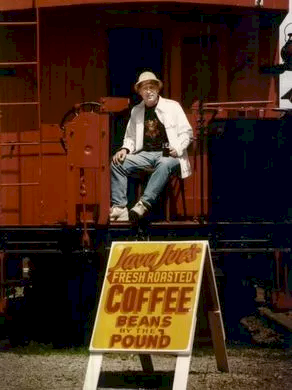
Joe on a train car marketing his coffee


Joe’s Label (one time). Looks like his picture doesn’t it! 🙂
Intense and intensely blue eyes
“Are you wanting the taste of burnt caramel, from a dark roast, for your espresso? Coffee is one thing, but espresso is another. One is for medium roast and the other for dark. Don’t confuse the two! Don’t burn the beans! You can’t taste anything from that black dark crap, other than burnt little pieces (over-roasted coffee beans), of charcoal in hot water! I don’t know what in the hell that is, but it’s not coffee! Don’t over-roast and burn the f—ing beans!”
-Java Joe-
Joe was a master roaster! Roasting it is both a highly developed skill and an art. So is or should be, the consumption of coffee! I now believe part of the reason Joe was never recognized world-wide, was mostly in part to our taught and continuing ignorance about coffee. Before 1957, most restaurants, diners, gas stations and homes were ‘perking’ their coffee on a stove in aluminum per-co-lators. This took time. And for the most part, everyone was drinking and selling dark, black, so-called coffee from a can, from probably either Folgers®️ or Maxwell House®️. They didn’t even roast, they baked the hell out of the beans.This is part of our history in the United States. Then in 1957, the paper filter and pour over brewer was invented and the Bunn coffeemakers were introduced commercially. Everyone at home still had to perk theirs until the home Bunn model became available, in 1963. The end results of Bunn ®️ were better and quicker, but everyone was still, for the most part drinking burnt, over roasted (or over-baked) coffee, roasted who knows when, from a can that had been packed in nitrogen to preserve it’s familiar aroma, for who knows how long. I wanted to write its burnt smell, but I wanted to be nice, but this is exactly what it is. Joe discovered more, so much, much more! There are around 1200 flavor profiles in coffee, all coffee, all the time, always! One never gets to tastes them if they are burnt out of them. They are all different, all the time and always. No two coffee origins will ever taste the same, every single time or even day to day. Well, that’s not good for consistency. That does not keep or grow your business, unless, your business is about educating and masterfully delivering on those complex and elusive. 1200 flavor profiles in coffee. I think this is in part, why Joe seemed prickly to many people. There is a lot of ignorance in the world of coffee. It’s one thing to be ignorant, but something entirely different to be stupid, when right teaching is available, and Joe was a willing and master teacher. Joe taught me that noone is ever going to be ‘coffee free’ until, they understand how coffee is supposed to taste, all 1200 flavor profiles and black. Now I still put cream and sugar in mine, but I can at least tell the difference between fresh and stale, and what real good roasted coffee tastes like instead of burnt, over-roasted, baked, fried or the nuclear crap called coffee. I’m not there yet, but I ‘m working on pure-black-coffee and getting myself free. Joe taught me and I’m repeating it here, you’ve never had coffee if all you know is burnt charcoal. Starbucks reformed the lie, made it consistent, rebranded and repackaged the most highly acidic and caffeinated burnt beverage in the marketplace today. They hyped it, made it a cultural thing and demand high prices for the privilege of drinking what has not been changed for well over a hundred years, burnt (over-roasted), coffee. OK, let’s suppose that caffeine is your thing. How does Starbucks®️ do it? Do they add even more? Do they bio-engineer the beans they buy? Probably not! Caffeine is in the bean itself. Some by their very nature have more of it or less than others. But here is the fact, a secret to most people. The longer your roast the beans, the more caffeine is removed! So why EVER over-roast or burn the beans??? Something more? Yes, I guess, that burnt taste? I know people that will never drink anything other than Starbucks®️, McDonalds®️, and other chains that each have their own version and consistent brands of burnt. Dunkin Donuts ®️ do not over-roast theirs,(except their dark roast), but use either blends or less quality beans, but not organic. They all live under the lie that it aint 🤣 isn’t or ares’nt 😂 coffee unless its burnt (whether they ever use or think of the word “burnt” or not), because that is what it is! A dark roast is not for coffee it’s for espresso etc. This is how I found and met Joe. Nick’s warning or heads-up to prepare me, was lost on me. I got Joe and his intensity and his intense, steel blue eyes, from the very first moment! He was real! No pretending, he was Joe, always just Joe, Java Joe!
Joe at another of his locations at the Public Market
” I think Kona coffee has a richer flavor than any other.”
Mark Twain, Letters From Hawaii
I would argue, for my favorite, Blue Mountain, from Jamaica. I lived there for awhile. I could have said, Joe, Mark Twain (Samuel Clemens), was a Missourian. So am I, born and raised. Missouri is, the Show Me state. I don’t think Mark (or Samuel), ever made it to Jamaica? But I lived there for awhile and Ian Fleming lived there for years, at his place he called, ‘Golden Eye’. There, he wrote many of his most famous books and introduced the world to, his fictional character, 007, “Bond, James Bond.” In Live and Let Die, Ian Fleming describes Jamaican Blue Mountain coffee as—“the most delicious coffee in the world!”
James Bond, ‘Live & Let Die’, By Ian Fleming
I will say this about my ‘Blue’ and Joe. At one time, in order for Joe to purchase Blue Mountain, it had to be a minimum of around 440 pounds in a wood barrel, shipped by boat, train and truck from Jamaica. You do the math. At the time, It sold retail, for $55 a roasted pound! And Joe, even though he liked Kona better, he could roast it exactly like I remembered it, when I had it in Jamaica! But at $55 a pound, I couldn’t afford that and I would only buy a half a pound around the holidays. But Joe had to move that coffee and at 440 pounds, it was quite a feat to do!
Joe taking a break and reading a newspaper, but never far from his roaster!
 Joe knew coffee in and out, everything about it, everything about each origin and how to bring out the best in each one. And this is what Joe and I would talk about, just coffee. In 1974, I was just starting to like coffee. In 2003, when I met Joe, I fell in love with coffee! ☕️
 Mike Calabrese, partner (L) and Joe (R), talking coffee over coffee, with a picture of Joe, by a chalk artist, on the wall behind.
No, Joe didn’t teach me how to roast coffee. Joe taught me how to love coffee and I think he would love that I can now, roast to my satisfaction with even greater love than he first imparted to me! I was never interested in roasting until about 2012. I still not interested in roasting commercially as a business. It is just a passion and a craft I have developed and because of Joe. I think he would be pleased to know that I am roasting on a open flame on my grill, in the garage, all year long— once a week and about two pounds at a time.
Joe was close as he ever could have been, to going viral and becoming a household name. There was a husband and wife team that started a bread company years ago called, Montana Mills. Oh, while their breads were rising, their locations and popularity were too! There was some big money behind them as they expanded rapidly. They approached Joe about a dual joint venture, a new concept store. One side would have Montana Mills and the other side with a pass-thru, would be Joe’s, selling whole roasted beans and fresh brewed coffee by the cup. The pass-thru could be closed, allowing either to open or close at their discretion. The first of several planned locations was constructed, I saw it, it was cool, but it never opened. When Joe found out that the owners wanted him to roast his coffee like ‘Scarchucks’, he told them to get the bean burners to roast for them, he was not going to over-roast and burn his coffee!! So, that was it. Later, Krispy Kreme Donuts bought Montana Mills. That did not last long! Today, you can only find Krispy Kreme Donuts in some grocery stores around here and the only evidence of Montana Mills was, Great Harvest Bread Company where they somehow were able to acquire, some of the original bread recipes, from Montana Mills.
Mike Calabrese, partner (L) and Joe (R), talking coffee over coffee, with a picture of Joe, by a chalk artist, on the wall behind.
No, Joe didn’t teach me how to roast coffee. Joe taught me how to love coffee and I think he would love that I can now, roast to my satisfaction with even greater love than he first imparted to me! I was never interested in roasting until about 2012. I still not interested in roasting commercially as a business. It is just a passion and a craft I have developed and because of Joe. I think he would be pleased to know that I am roasting on a open flame on my grill, in the garage, all year long— once a week and about two pounds at a time.
Joe was close as he ever could have been, to going viral and becoming a household name. There was a husband and wife team that started a bread company years ago called, Montana Mills. Oh, while their breads were rising, their locations and popularity were too! There was some big money behind them as they expanded rapidly. They approached Joe about a dual joint venture, a new concept store. One side would have Montana Mills and the other side with a pass-thru, would be Joe’s, selling whole roasted beans and fresh brewed coffee by the cup. The pass-thru could be closed, allowing either to open or close at their discretion. The first of several planned locations was constructed, I saw it, it was cool, but it never opened. When Joe found out that the owners wanted him to roast his coffee like ‘Scarchucks’, he told them to get the bean burners to roast for them, he was not going to over-roast and burn his coffee!! So, that was it. Later, Krispy Kreme Donuts bought Montana Mills. That did not last long! Today, you can only find Krispy Kreme Donuts in some grocery stores around here and the only evidence of Montana Mills was, Great Harvest Bread Company where they somehow were able to acquire, some of the original bread recipes, from Montana Mills.

A lot can be said about a man, by the boy and his dog! 😊 [Joe and Friend]
Joe used to only sell coffee beans in paper bags.
“What do you need cans of nitrogen packed coffee for to preserve it’s freshness? Coffee is meant to be brewed and consumed, in 7-10 days, from when it was first roasted, not years ago!”
-Joe-


“When you taste our coffee I personally guarantee it will be the best coffee you ever tasted.”
Java Joe

Looking through the door of Joe’s Place 6/26/19. Just like when he was here, the lights were off. I can imagine him sitting in his chair in front of his roaster
What led me to this journey—
Living in Jamaica for a time opened my eyes to the movement of coffee across the islands — from Haiti to Jamaica, and from Jamaica back to Haiti. That passage between lands stirred my own exploration into the origins of coffee. Years afterward, those same pathways inspired what I eventually called my RESET blend — not as invention, but as a rediscovery of the historic trek of coffee across islands and generations.
To pay tribute to the man who taught me to love coffee, I returned to Java’s with the hope that my blend might, in some small way, stand as a gesture of gratitude to the original, the one and only, Java Joe — or simply, my friend Joe.
In closing, all I can write is: Thank you, Joe!
I miss our good conversations, but I smile and imagine you on some beach in Hawaii, playing golf in your bare feet, roasting, grinding, brewing, and enjoying Kona — your favorite — and maybe even getting a chuckle about me roasting coffee with my popcorn popper and skillet, while still loving my Blue Mountain (when I can afford it).
☕️ Yes, Joe, I still love coffee!
Still and forever your friend,


 Gathering Place Coffee Roasters